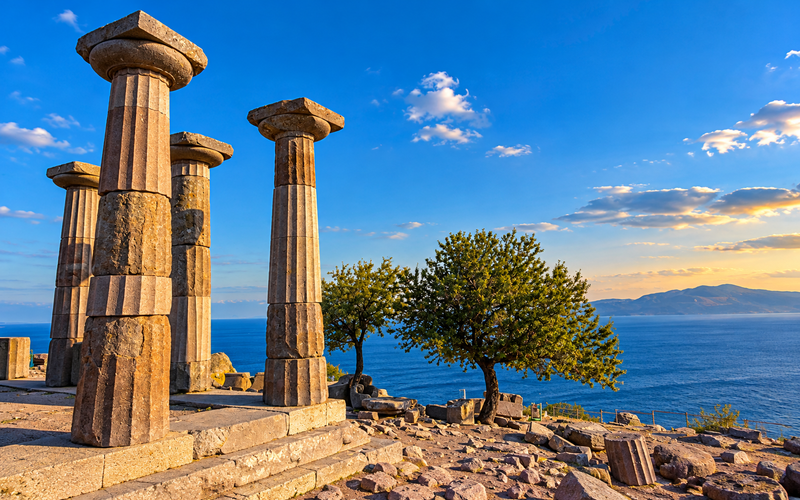
High on a volcanic hill above the Aegean, the columns of a 2,500-year-old temple frame one of the finest sunset views on Turkey's coast. Assos was the city where Aristotle lived and taught, where St Paul boarded ship on his travels, and where stone sarcophagi were said to consume the dead. Its walls, theatre and terraces still descend towards the sea much as they did in antiquity. This guide covers everything you need to know before you visit.
Where Is Assos?
The ancient city of Assos lies within the village of Behram, better known as Behramkale, in the Ayvacık district of Çanakkale province. Though it was a harbour city, Assos was built on and around a rocky volcanic hill rising about 238 metres above the Aegean shore. From the top, you look straight across the Gulf of Edremit to the Greek island of Lesbos.
Assos is about 60 km (37 miles) from our hotel and makes an ideal day trip combined with other sites in the Ayvacık area.
A Short History of Assos
According to ancient writers, Assos was founded in the 7th century BC by Aeolian settlers from Lesbos. Recent archaeological work has shown that the site was already inhabited in the Bronze Age.
Its most famous resident was the philosopher Aristotle. Invited by Hermias, the ruler of Assos, he lived and worked here between 347 and 345 BC. In the Roman period, Assos remained an important harbour and trading city.
Assos also appears in the New Testament. According to the Acts of the Apostles (20:13–14), St Paul walked here from Troas while his companions went ahead by sea; they took him on board at Assos and sailed on to Mitylene on Lesbos. You can read about the harbour he set out from in our Alexandria Troas guide.
The area came under Turkish rule in the 14th century. In 2017, Assos was added to UNESCO's Tentative List of World Heritage Sites.
The Temple of Athena
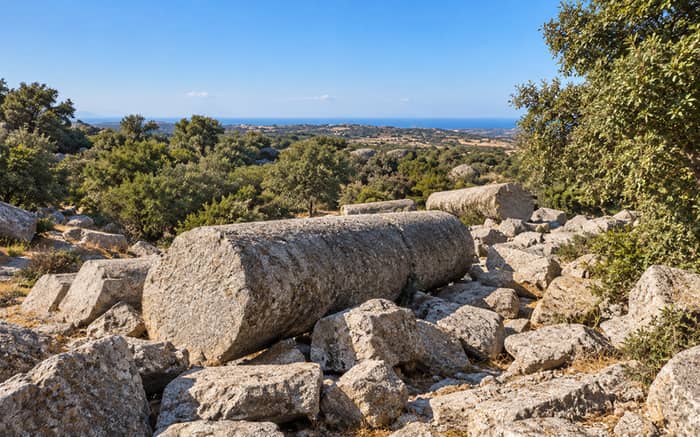
The symbol of Assos is the Temple of Athena, standing on the acropolis at the highest point of the city. Built in the 6th century BC, it was dedicated to Athena, the city's protective goddess.
The temple is the first and only known example of a Doric temple built in Anatolia during the Archaic period. Its decorated friezes and metopes show mythological scenes and fighting animals. The view from the temple over the Gulf of Edremit and Lesbos is especially striking at sunset.
The Agora, Stoas and Council House
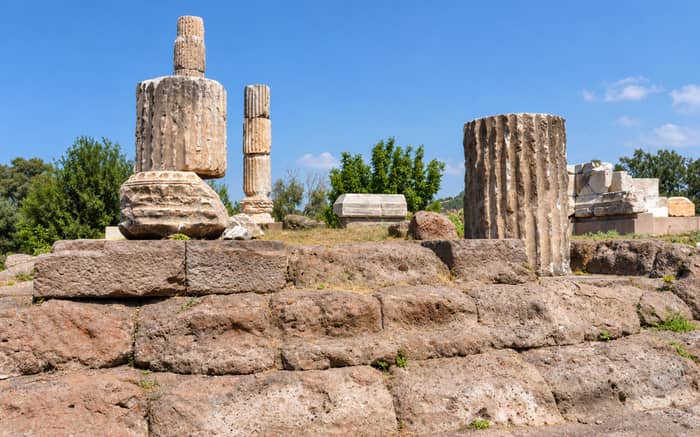
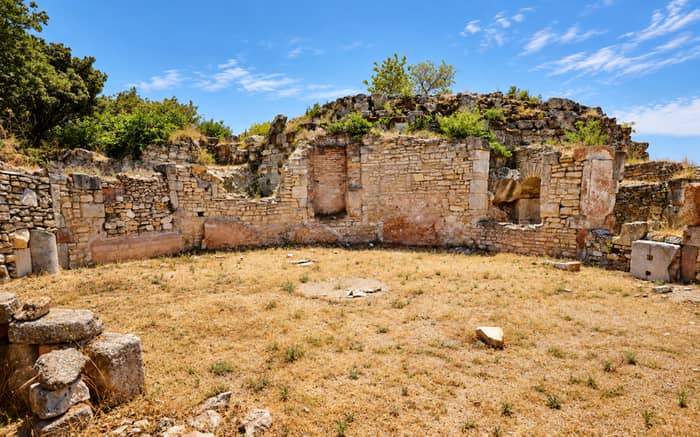
The agora, the city's public square, sits on terraces on the southern slopes below the acropolis. It was flanked by a two-storey stoa (colonnaded hall) on its northern side and a four-storey stoa on its southern side. The official buildings were grouped on the narrow eastern end of the agora, where the remains of the bouleuterion, the council house, can still be seen.
The Gymnasium, Baths and Theatre
Between the agora and the great western gate lies the gymnasium, where young citizens trained and studied. Walking down from the west side of the agora towards the sea, you pass the baths and then reach the theatre, which seated about 5,000 people and was used in both the Greek and Roman periods. Facing the sea, it shows better than any other building how closely the city was tied to its harbour.
The City Walls and the "Flesh-Eating" Sarcophagi
The city had two main gates, one to the east and one to the west, and a large part of its fortification walls still stands today. Almost every building in Assos was made from andesite, a volcanic stone that is hard to work but extremely durable.
Outside the walls, the areas to the east, west and north served as necropolises. The most extensively excavated is the Western Necropolis, crossed by a paved Archaic road dating to the 6th century BC and lined with tombs and sarcophagi.
In Roman times, Assos was famous for its andesite sarcophagi, which were shipped to many parts of Anatolia. The Roman writer Pliny the Elder claimed that the stone of Assos consumed the bodies laid in it within forty days. The very word "sarcophagus" comes from the Greek for "flesh-eating".
Ottoman Assos: Hüdavendigar Mosque and Bridge
Two important early Ottoman buildings survive at Assos. The single-domed Hüdavendigar Mosque, at the northern corner of the acropolis, was built in the 14th century by Sultan Murad I.
The Hüdavendigar Bridge, also known as the Behramkale Bridge, spans the Tuzla stream. According to the Turkish Ministry of Culture and Tourism, the bridge is fully intact and still in use.
Excavations and Finds Around the World
The first scientific excavations at Assos were carried out in 1881–1883 by the Archaeological Institute of America, led by J.T. Clarke with F.H. Bacon. Excavations resumed in 1981 under Professor Ümit Serdaroğlu of Istanbul University, and since 2006 they have continued under Professor Nurettin Arslan and his team from Çanakkale Onsekiz Mart University.
Some of the finds from Assos are now displayed in the Louvre in Paris, the Museum of Fine Arts in Boston, the Istanbul Archaeology Museums and the Troy Museum in Çanakkale.
Visiting Assos: Practical Tips
- Opening days: The site is open every day. Hours differ between summer and winter, so check the official site page before you go.
- Sunset at the temple: According to the Ministry, the Temple of Athena area may stay open later in the evening between 1 June and 15 September, depending on sunset times.
- Admission: There is an admission fee for adults. Children under 8 enter free. Check the official page for current prices.
- Walking: The acropolis is reached on foot through the village of Behramkale. Paths are steep and stony, so wear sturdy, non-slip shoes.
- Parking: The village streets are narrow and steep, so you may need to leave your car in the parking area at the village entrance.
- How long to stay: Allow at least 2 to 3 hours for the acropolis and the lower city.
How to Get to Assos
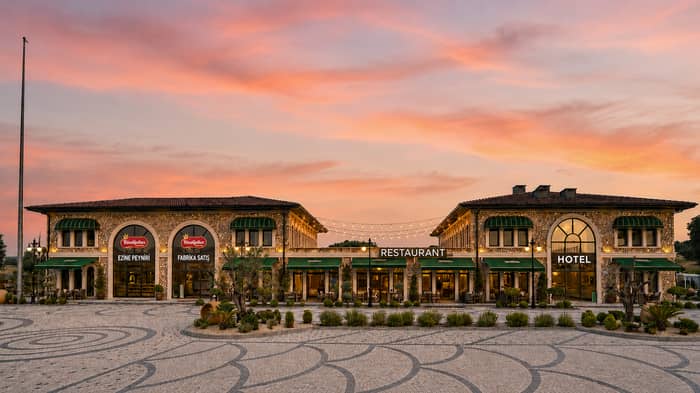
Yükseloğulları Otel is located on the Çanakkale–İzmir highway in Bozeli village, Ezine, about 60 km (37 miles) from Assos. Enter "Assos Archaeological Site" or "Behramkale" into your navigation app. Directions to our hotel are on our Location & Getting Here page.
We recommend combining Assos with the Temple of Apollo Smintheus, about 25 km away, and Babakale, the westernmost point of mainland Asia. Visit the Smintheion in the morning, continue to Assos in the afternoon and end the day with sunset at the Temple of Athena.
After Assos, Back at Our Hotel
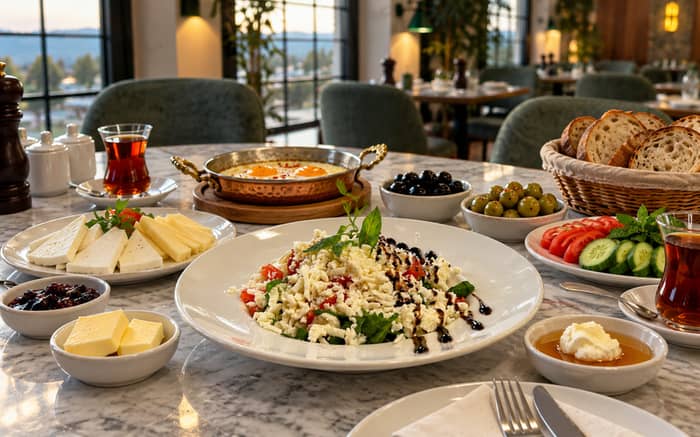
After sunset, our restaurant is open until 23:00, serving the traditional flavours of the North Aegean. Breakfast is included for hotel guests, with the Ezine cheese our family has made since 1953 at the centre of the table.
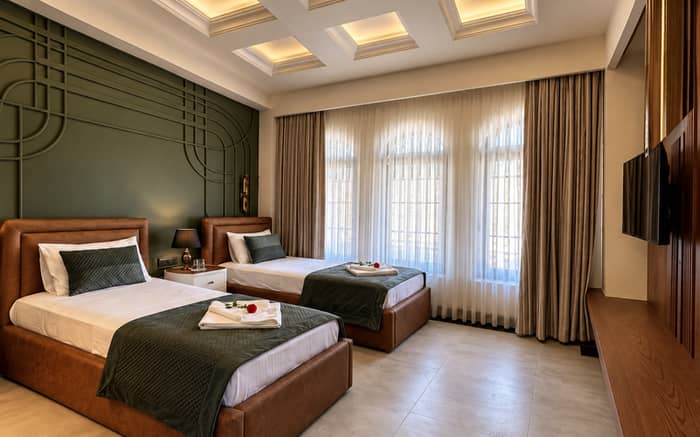
You can view our rooms and book directly with us.
Assos: What Visitors Want to Know
Are Assos and Behramkale the same place?
Yes. Assos is the name of the ancient city, while Behram, or Behramkale, is the present-day village built on and around it. Both names are used for the same place.
Why is the Temple of Athena at Assos important?
Built in the 6th century BC, it is the first and only known Doric temple from the Archaic period in Anatolia. Its friezes and metopes with mythological scenes also make it an important work of early Greek architecture.
Did Aristotle really live in Assos?
Yes. Aristotle lived in Assos between 347 and 345 BC at the invitation of Hermias, who ruled the city at the time.
Is Assos mentioned in the Bible?
Yes. According to Acts 20:13–14, St Paul walked from Troas to Assos, where his companions took him on board ship before sailing on to Mitylene on Lesbos.